
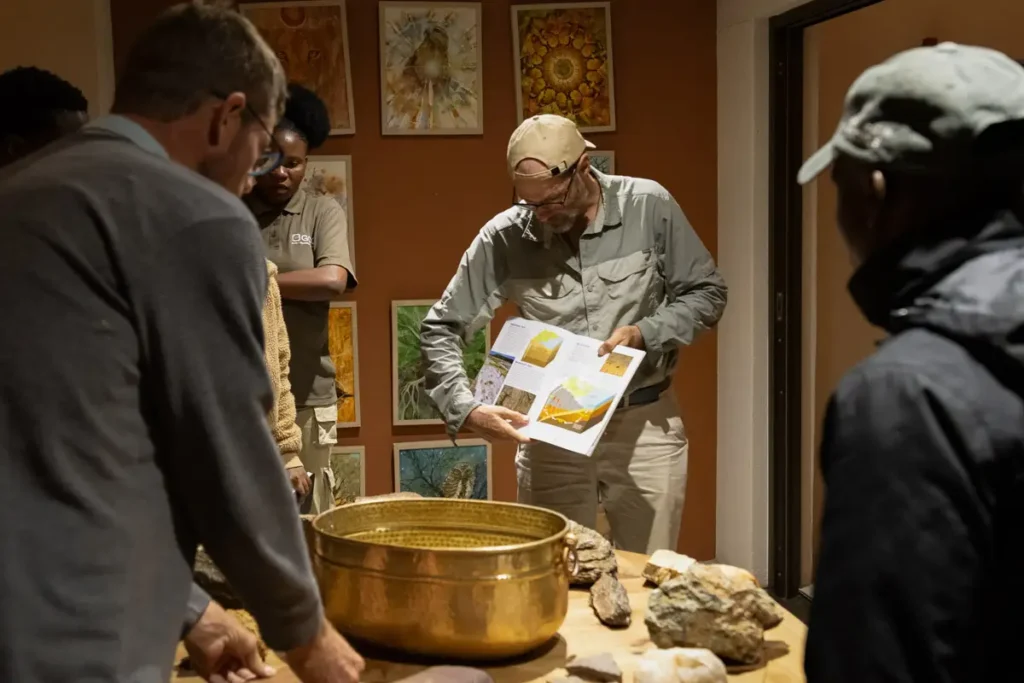
To many nature lovers, geology is the awkward uncle at the family gathering – always there in the background, but often misunderstood and overlooked. But over the following 24 hours, fuelled by John’s infectious enthusiasm, we realised just how vital, and fascinating, this field truly is.
Motivated by the previous evening’s talk on plate tectonics and the secrets rocks hold about our planet’s past, the group set off into the bush at first light. As the warm pinks and golds of sunrise broke across the horizon, John called us to a halt. Here, he set the scene with a quote from Maria Popova:
“Every rock we touch is the emissary of timescales we cannot begin to comprehend without confronting our own transience, and yet radiating from it is also the quiet assurance that the world goes on and on, that we are part of something vast and magnificent, that beneath all the tumult and turmoil of our human lives there is a steadfast continuity that anchors life to eternity.”
As we paused to consider the true depth of these words, a lion began roaring nearby – somehow connecting this vast, unimaginable river of time to the present moment. The understanding that the history written all around us has culminated in this incredible wilderness today.
Over the course of the morning, Earth’s story unfolded before us; from marvelling at ancient rocks formed over 3.5 billion years ago in the oceanic crust, to exploring stone tools created long before history was written or fences were drawn. Each stop we made wrote a different chapter as John encouraged us to engage not only our eyes, but our hands – to feel even the subtlest of changes.
Where once we saw a ‘pile of rocks’, we began to see a hidden record of pre-historic Earth. Dolerite dikes, explosive incursions and rainstorms spanning centuries came together to shape the land before us, explaining everything from the rise of the Phalaborwa mines to the looming Drakensberg escarpment.
At one point, as we strived to explain the colours, shapes and textures of different rocks by the dam, a lone elephant bull wandered nearby, hopeful of a drink. Such was our enrapture in our task, barely a head turned in recognition of this uninvited guest. Instead, we mused over flecks of shiny mica and pondered the difference between igneous and metamorphic, granite and gneiss, quartz and hornblende. How did it form? What secrets does it reveal?
As the hot, African sun beat down upon us, we finished with one last walk of discovery to an Iron Age smelting oven. John explained how layers of hardwood charcoal and bellows were used to reach 1200°C – melting iron from ore with remarkable skill before trading it off the coast of Mozambique. It was here, uncovering relics and tools from the past – including a primitive grinding stone – that our journey across the ages finally came to an end. From the formation of Earth to early human civilisation – an unfathomable and captivating story written in the rocks of Koru Camp.
Reflecting on the experience, Mpho, a self-study student guide with Ditoro Outreach, commented “Putting hands on the rocks that we learned about helped me to understand. I can now tell people different kinds of rocks and the minerals and materials that make them up”.
Gilly, also from Ditoro, added “As I was studying for my FGASA exam, I didn’t quite understand the geology module very well, and I struggled a lot when it comes to identifying rocks. But after the sessions at Koru Camp, now I understand the process it takes to form a rock, the different minerals, and how time affects the whole process. One thing that fascinated me the most is aging the rocks. Imagine the youngest rock being around 2.6 billion years old! That threw me off. Thanks for this great opportunity.”
We extend our heartfelt thanks to John for sharing his time and passion, to our partners at Sashwa River of Stars for hosting, and to the students of Global Conservation Corps and Ditoro Outreach for bringing such energy and curiosity.
As we gain a deeper understanding of the forces that have shaped this land over billions of years, it’s a powerful reminder of how privileged we are to be here – and a call to action. Because what took eons to create could be lost in a single generation, unless we choose to protect it.